What Actually Happens When Someone Blind Steps Into a Robotaxi
Source: Voice of the Blind on Facebook
When Tesla rolled its Cybercab into the National Federation of the Blind's convention in Austin last week and walked attendees through the accessibility features it had built in — Braille on the physical controls, room for a guide dog or a folded white cane, seats set at a height that doesn't turn every transfer into a small negotiation with gravity — it read, at first glance, like a company finally doing its homework. Elon Musk even posted about it himself, which if nothing else meant somebody at Tesla decided this was worth being seen caring about. We asked our community what they thought: is this something you'd actually ride, or does it just raise more questions than it answers? Seventeen comments and replies later, the answer turned out to be both, and the shape of that "both" says a lot about what it's like to evaluate a piece of technology that was, for once, actually built with blind riders in mind — instead of retrofitted for them after the fact.
The Questions a Keynote Never Answers
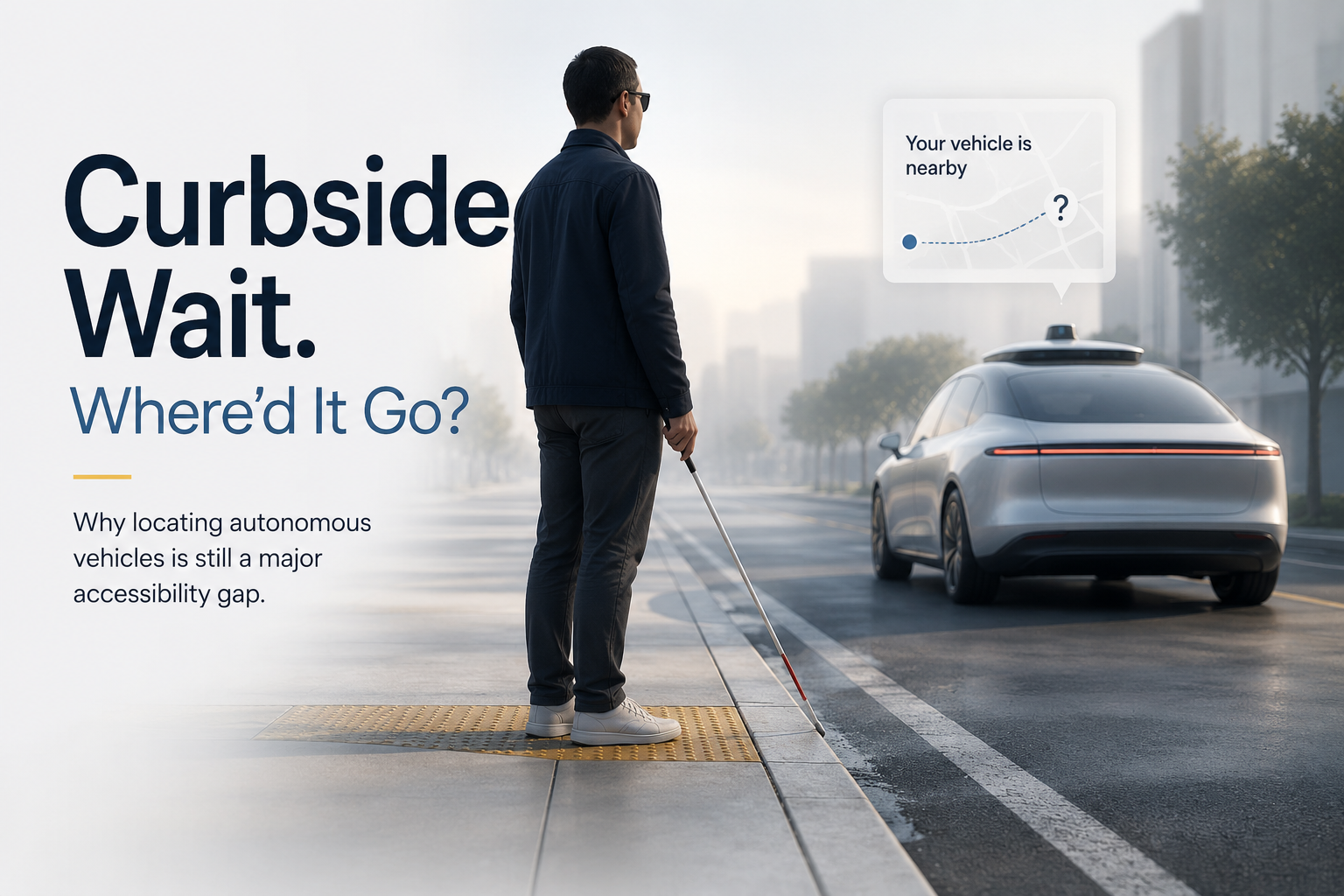
The first thing that came up wasn't excitement or dread, it was logistics — the unglamorous stuff that never makes it into a keynote. Somebody asked flatly whether you'd need a driver's license just to activate the thing, a question that sounds almost obvious but actually cuts right to the point: is this designed around the assumption that a sighted person is always somewhere in the loop? Others picked at the layer underneath that: what happens after the ride ends. One commenter described a friend who ordered a self-driving Uber and then simply couldn't find the car once it arrived — no driver to call out, no window to knock on, just a vehicle sitting somewhere nearby that might as well have been invisible. Someone else admitted point blank that her real fear isn't the driving part, which she said she's basically made peace with, it's the drop-off — getting deposited on the wrong side of a street, or somewhere that isn't actually near where she meant to go, with no easy way to reorient. Another commenter offered a fix worth noting: use Aira, or grab the coordinates the app gives you, to get a clearer fix on exactly where you've landed. That exchange is basically the whole thread in miniature — the tech promises door-to-door independence, and the community immediately starts stress-testing the door part, because that's the part nobody in a product demo ever bothers to show.
Convention Booth or the Real Thing
Running underneath the practical questions was a second, blunter one: is any of this actually real, or is it a very well-lit convention booth. A few people were openly skeptical that what got shown in Austin bears much resemblance to what will exist on a street corner in three years, let alone this year. One comparison that stuck: this has the feel of a parent in the grip of addiction promising a kid the moon and then handing over an empty paper bag where lunch was supposed to be — a big, generous-sounding gesture that doesn't survive contact with follow-through. Someone else was more measured, calling it not ready for primetime but genuinely promising, and putting a rough three-to-five-year timeline on when it might actually be usable. That gap — between "they demoed this for us" and "I can count on this to get me to work" — is where a lot of the thread's energy lived. Nobody was arguing that Braille buttons are bad. The argument was about whether Braille buttons are the whole story, or just the part that's cheap and easy to photograph.
Who Actually Gets to Afford Independence
Money came up too, and it complicated the optimism in a way that's worth sitting with. Someone pointed out that the last time they checked, Tesla's actual self-driving capability was gated behind something like a thousand-dollar-a-month subscription — a number that turns "accessible transportation" into a pretty exclusive club fast. Another commenter's response was shorter and sharper: most of the people worried about affording this shouldn't be worried about the tech, they should be worried about the fact that Social Security isn't going to cover it. That's not a knock on the engineering. It's a reminder that for a lot of this community, the barrier to independent transportation was never really about whether the technology existed — it's about whether anyone building it has priced in the reality that a large share of blind and low-vision people live on fixed, modest incomes. A robotaxi with a Braille keypad doesn't mean much if the meter never stops running.
The Safety Argument Nobody Finished
And then there was the fight nobody quite finished — the one about whether it's fair to get excited about this at all while Tesla's broader safety record is what it is. One commenter didn't hold back, pointing to a pattern of Teslas hitting houses and other vehicles in situations he argued a merely competent human driver would have avoided, and said that was enough for him to pass regardless of the Braille. Someone pushed back hard, essentially arguing that human drivers kill far more people every year than autonomous ones ever have, so the standard being applied here was lopsided. It got heated — pointed enough that some of what was said is worth reading in its original wording rather than paraphrased. But underneath the heat was a real question the rest of the thread was circling too: whether you can meaningfully separate "this company built something thoughtful for disabled riders" from "this company's cars have a track record that makes some people nervous to get in one at all." Several people in the thread clearly can hold both of those at once. A few can't, or won't, and said so.
What the Thread Actually Adds Up To
What's striking, reading all of it together, isn't that the community split into cheerleaders and skeptics. It's that almost nobody treated this as a simple yes-or-no. The people most enthusiastic about eventually owning one were often the same ones who'd already thought through what happens if the car drops them somewhere wrong. The people most skeptical about Tesla's safety record weren't dismissing the idea of autonomous transportation itself, just this particular execution of it. That's the throughline: this wasn't a group reacting to a press release, it was a group of people who've spent years being promised independence by products that quietly assumed someone sighted would be there to catch the gaps, running this one specific idea through everything they already know about what actually breaks down in practice. A demo in Austin can show Braille on a button. It can't show you what it's like to stand on a curb you can't identify, waiting for a car that already left. Whether Tesla or anyone else closes that second gap is still very much an open question — and if this thread is any indication, this community is going to be the one asking it loudest, and asking it long after the keynote ends.
Read the original post and the full comment thread on Voice of the Blind's Facebook page.